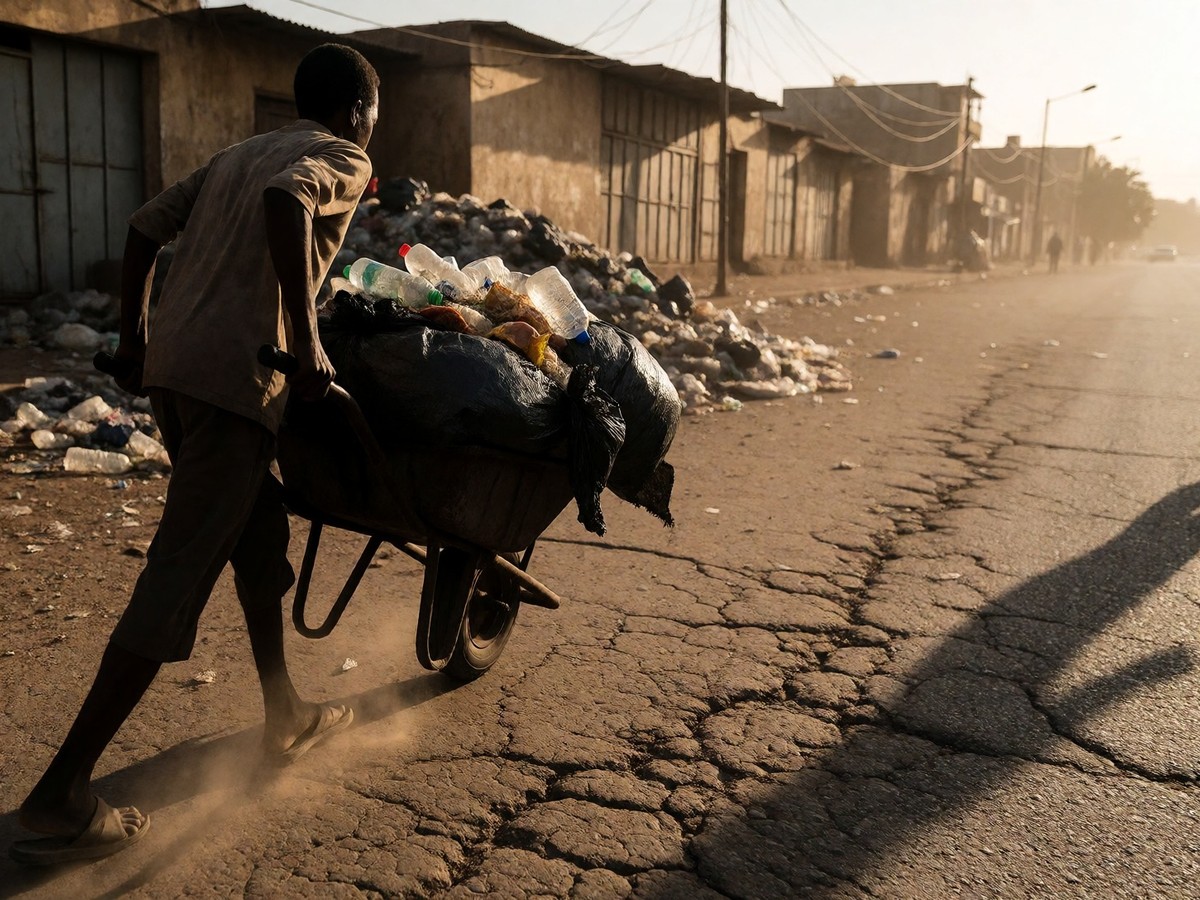
Rubbish piles overwhelm returning residents
Musa Abdelrahman, 54, returned to his neighborhood near Khartoum International Airport in March via a government repatriation scheme. The war between the Sudanese Armed Forces and the Rapid Support Forces began in April 2023 and killed tens of thousands of people. After the Sudanese Armed Forces recaptured the capital in March 2025, the city saw a massive influx of residents. By October 28, 2026, approximately 2.88 million people had returned to Khartoum State, which is the highest number of returnees among all Sudanese states even as the city struggles with broken infrastructure and services. The war in Sudan created one of the world’s worst humanitarian crises, causing about nine million people to be displaced and pushing poverty rates down to levels last seen in the 1980s. When rubbish collection trucks fail to arrive, neighborhoods turn into open dumps where residents face foul smells and swarms of insects. Abdelrahman says the problem affects daily life because he wants to live in a clean environment with regular waste collection instead of waiting for rubbish to pile up until it becomes a bigger problem.
Public health risks and broken services
The destruction of waste management infrastructure and the loss of workers create a growing crisis in residential areas. The Khartoum State Cleaning Cooperation reports that the war caused the loss of 90 percent of its sanitation and waste transportation fleet through theft or damage. This loss includes 127 smaller vehicles used for collection and 9,000 large waste containers previously used in markets and public squares.
| Sanitation Asset | Quantity Lost or Damaged |
|---|---|
| Small collection vehicles | 127 |
| Large waste containers | 9,000 |
| Total sanitation fleet | 90% |
Saeed Koko, a refuse collection worker, says vehicles now mainly operate in major markets while many residential neighborhoods lack regular services. He says the war displaced many workers and the city lost specialized personnel because of the conflict. Sawsan Omar, a resident of Omdurman, says people resort to burning piles of rubbish, which prevents them from sitting outside or opening windows. Dr. Al-Fatih Mahmoud, a public health specialist, says that inhaling emissions from these fires can cause irritation of the eyes, nose, and throat. He notes that these fumes can cause coughing and shortness of breath, while also worsening asthma or bronchitis. He adds that children, older people, pregnant women, and individuals with pre-existing respiratory conditions are particularly vulnerable to these health risks. The accumulation of waste also creates favorable conditions for flies, mosquitoes, and rodents to breed, which increases the risk of disease. Dr. Mahmoud warns that the decomposition of waste may increase the risk of gastrointestinal diseases like diarrhoea, gastroenteritis, typhoid, and cholera. He also notes that the situation could spread insect-borne diseases like dengue fever and malaria depending on the prevalence of disease-carrying vectors. The United Nations High Commissioner for Refugees cited the lack of solid waste management services as a growing concern for the millions of people who have returned to the capital. Damage to maintenance workshops and spare parts warehouses has also hindered the ability to manage waste.
Government intervention and international aid
The Sudanese government launched a 50-day sanitation campaign in Khartoum State this month, involving various government institutions, ministries, and different sectors of society to address the growing garbage crisis. Nour al-Daem Taha, the mineral resources minister and head of the committee overseeing the initiative, says the central government decided to support the state efforts by mobilizing resources and rehabilitating machinery. Political analyst Ali Mansour Hasballah says restoring services requires more than temporary clean-up campaigns because the war damaged refuse facilities and caused widespread vandalism against public property. He says the impact of the war in Khartoum has extended to essential services like electricity, healthcare, and water. On November 4, 2026, Japan and the Japan International Cooperation Agency announced a $4.5m project with the United Nations Human Settlements Programme to help clear rubble in Khartoum State. This project also aims to improve the aesthetics of the city by clearing wrecked and abandoned vehicles from the roads. Sawsan Omar says the campaign must reach residential neighborhoods and side streets rather than just focusing on markets and government institutions. She fears the government scheme might neglect poorer and remote neighborhoods in the capital. She says residents want to see tangible results that continue after the campaign ends rather than a temporary effort lasting only 50 days.